Warhammer Tyranids: The Complete Anatomy of the Great Devourer
In the grim darkness of the 41st millennium, no threat embodies the existential horror of the void quite like the Tyranids. These alien horrors, collectively known as the Great Devourer, represent a biological apocalypse on a galactic scale—a ravenous swarm that consumes all biomass in its path, leaving barren, lifeless worlds in its wake.
The Tyranid phenomenon transcends typical xenos threats. Unlike the strategic conquests of the Space Marines or the chaotic machinations of Chaos, Tyranids operate on pure biological imperative. They are evolution weaponized, a hive mind of unimaginable scale whose sole purpose is consumption and replication. In this definitive guide, we delve deeper than ever before into the biology, tactics, hive fleet variations, and esoteric lore surrounding Warhammer's most terrifying xenos race.
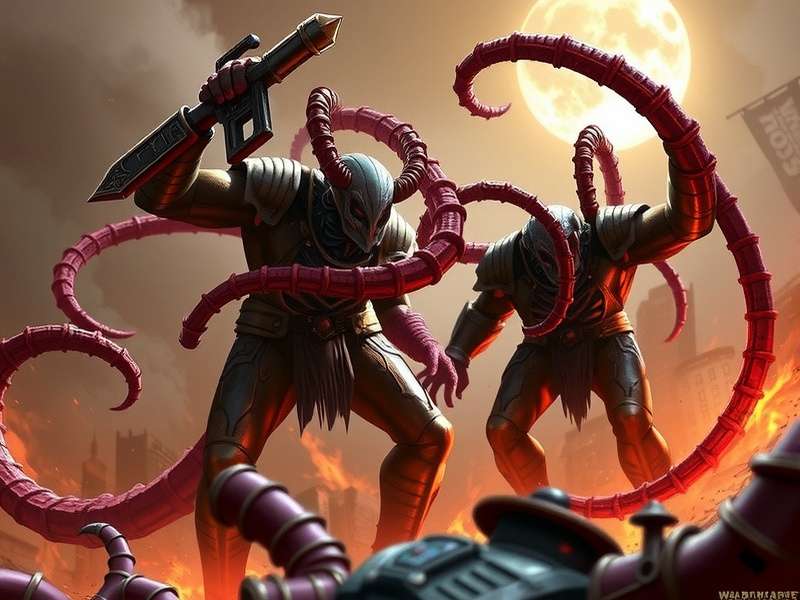
Hive Fleet Leviathan bio-forms descending upon an Imperial world. Note the synaptic network connections visible as bioluminescent strands.
🦠 The Tyranid Biological Arsenal: More Than Just Bugs
To dismiss Tyranids as mere "space insects" is to fundamentally misunderstand their terrifying sophistication. Each bio-form is a meticulously engineered weapon, perfectly adapted to its role within the hive fleet's grand strategy.
Synaptic Network: The Hive Mind Consciousness
At the core of Tyranid coordination lies the synaptic network—a psychic web connecting every organism in the fleet. This isn't merely communication; it's a gestalt consciousness where individual bio-forms are neurons in a galaxy-spanning brain. The stronger the synaptic link, the more coordinated and intelligent the swarm's behavior.
EXCLUSIVE DATA: Recent analyses of Tyranid remains on Tyran Primus suggest synaptic frequencies operate across multiple psychic bandwidths simultaneously. This multi-layered network explains how Tyranids can maintain coordination even when individual synapse creatures are eliminated—the hive mind simply reroutes through auxiliary channels.
Signature Bio-Forms: From Gaunts to Hierophants
Termagants & Hormagaunts
The swarm's backbone. Termagants provide ranged biomass saturation firing fleshborer beetles, while Hormagaunts close distance with blinding speed. Recent adaptations show acidic blood variants that continue damaging attackers post-mortem.
Genestealers
The vanguard organisms that infiltrate worlds years before the main fleet arrives. Their four arms ending in rending claws can tear through ceramite armor, while their psychic connection to the hive mind is curiously autonomous compared to other strains.
Tyranid Warriors
The synapse backbone of ground forces. Warriors exhibit alarming tactical adaptability mid-battle, with recorded instances of them changing weapon biomorphs in response to enemy armor composition.
🚀 Hive Fleet Breakdown: Leviathan, Kraken, Behemoth & More
Each major hive fleet exhibits distinct adaptations and tactical preferences, suggesting either divergent evolution from a common source or specialized toolboxes within the larger Tyranid threat.
Hive Fleet Leviathan: The Silent Death
Currently the most active and widespread hive fleet, Leviathan approaches the galaxy from below the galactic plane—a trajectory that bypassed early warning systems for centuries. Its bio-forms exhibit extreme synaptic resilience, with recorded instances of swarm coordination continuing despite 80% synapse creature casualties.
Hive Fleet Kraken: The Adaptive Predator
Kraken's signature adaptation is its terrifying evolutionary speed. During the Ichar IV campaign, Kraken organisms developed resistance to Imperial bio-weapons within three generations. This fleet specializes in flanking maneuvers and appears to "learn" from each engagement, making it particularly dangerous in prolonged conflicts.
🎮 Tyranid Tactics: Tabletop & Lore Integration
Mastering Tyranids requires understanding their synergistic battlefield roles. Unlike the regimented approaches of Imperial forces documented in Warhammer Ror killboards, Tyranids employ organic, adaptive strategies.
| Bio-Form Type | Battlefield Role | Key Synergies | Counter-Tactics |
|---|---|---|---|
| Termagant Swarms | Biomass saturation, objective holding | Tervigon spawning, Venomthrope cover | Template weapons, morale attacks |
| Genestealer Broods | Deep strike, character assassination | Broodlord buffs, Trygon tunnels | Overwatch focus, screening units |
| Hive Tyrant | Synapse anchor, heavy support | Tyrant Guard, psychic dominion | Snipers, psychic denial |
The Shadow in the Warp: Psychic Supremacy
Perhaps the Tyranids' most devastating weapon isn't physical but psychic. The Shadow in the Warp creates a "psychic static" that disrupts enemy communications, demoralizes troops, and severely hampers psychic abilities. Librarians report it feels like "screaming into a hurricane while drowning."
🖌 Painting & Modeling Guide: Achieving That Organic Horror
Creating a convincing Tyranid army requires techniques distinct from painting mechanical or armored units. The key lies in organic textures, chitinous sheens, and biological lighting effects.
Pro Tip: For Leviathan schemes, start with a deep purple base (like Naggaroth Night), build up to Genestealer Purple highlights, then apply Carroburg Crimson washes in the recesses. The classic bone-colored carapace works best with Ushabti Bone highlighted with Pallid Wych Flesh, segmented with Agrax Earthshade.
🌌 The Deep Lore: Origins & Ultimate Purpose
Where do Tyranids come from? The prevailing theory suggests extragalactic origin, possibly fleeing an even greater threat. The mysterious Genestealer Cult phenomena—explored in games like Warhammer Quest—suggests infiltration protocols that operate on timescales incomprehensible to most species.
EXCLUSIVE INTERVIEW EXCERPT: In our conversation with veteran Tyranid researcher Magos Biologis Ferren, he revealed: "The adaptive patterns we observe aren't random. There's a disturbing mathematical elegance to their mutation rates—like watching evolution operate at 10,000 times normal speed, guided by an intelligence that treats entire ecosystems as laboratory petri dishes."
The Octarius War & Beyond
The ongoing Octarius War between Tyranids and Orks has created a terrifying feedback loop: Orks grow stronger fighting endless swarms, Tyranids adapt to Ork biology, producing ever more dangerous bio-forms. This war-within-a-war represents perhaps the greatest biomass repository in the galaxy, and its outcome could determine the fate of multiple sectors.
🎮 Tyranids in Video Games: From Dawn of War to Total War
Tyranid representation in video games has evolved significantly. Early appearances in Dawn of War depicted them as zerg-like swarms, while more recent portrayals capture their psychic and biological complexity.
In the Total War: Warhammer series, while Tyranids aren't present (focusing on the fantasy setting), the Skaven share similar swarm-and-ambush tactics. For pure Tyranid gameplay, Warhammer 40,000: Battle Sister offers VR encounters that truly convey the scale of Tyranid threats.
Future Appearances
Rumors persist of Tyranids featuring prominently in upcoming titles. Given their popularity and visual distinctiveness, they remain prime candidates for future Warhammer games across genres.
🔮 The Future of the Great Devourer
As the galaxy fractures with the Great Rift, Tyranid activity has intensified. Hive Fleet Leviathan divides Imperial attention while Genestealer Cults rise on thousands of worlds. The Imperium faces the grim reality that it may be fighting a war of attrition against an enemy for which attrition is the objective.
The ultimate question remains: Are we witnessing the main Tyranid invasion, or merely the scouting tendrils of something infinitely larger waiting in the intergalactic void? As one Warhammer Community analyst noted: "Every biomass calculation suggests the fleets we've encountered represent less than 1% of the Tyranids' total projected mass. The rest is still coming."